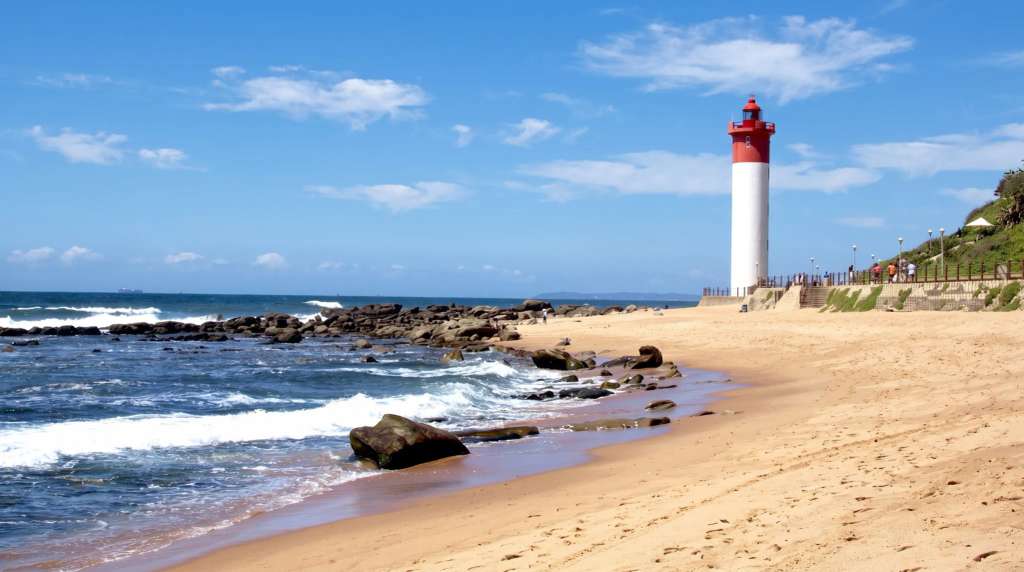
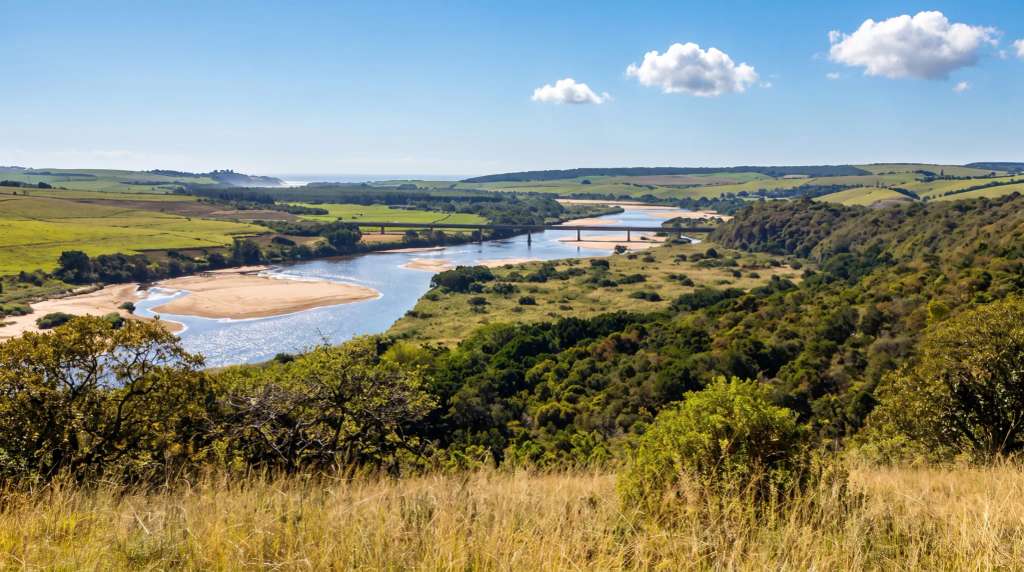
Zinkwazi is one of those places on the KwaZulu-Natal North Coast that people find through a recommendation rather than a billboard. It sits between Ballito to the south and just past the Nonoti River mouth to the north, a small coastal village where the main draw is the absence of the resort infrastructure that defines much of the coastline to the south.
Families come for the peace, the quiet and the space. Couples come for the charm. Groups of friends come because Zinkwazi offers a little something for everyone.
Of all the things to do in Zinkwazi, visitors often find more to indulge in than the village's low profile suggests and this guide covers it all.
Swimming at Zinkwazi Beach
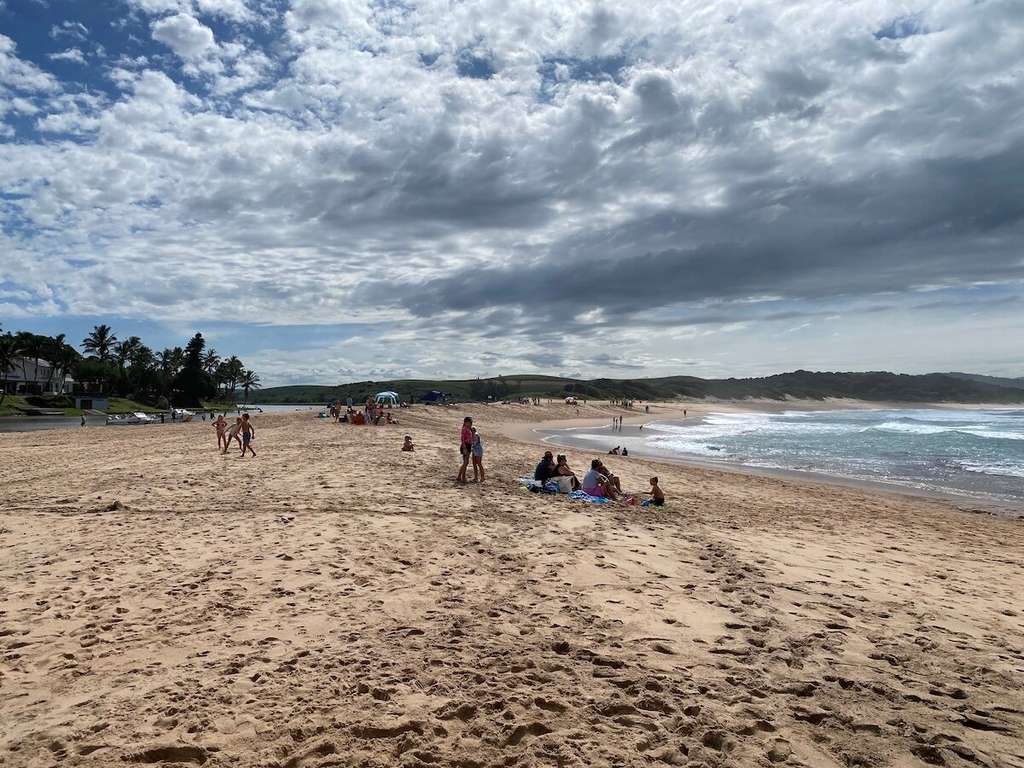
The choice between the lagoon and the main beach is the first decision most visitors make, and it shapes the whole day. They are different bodies of water with different characters.
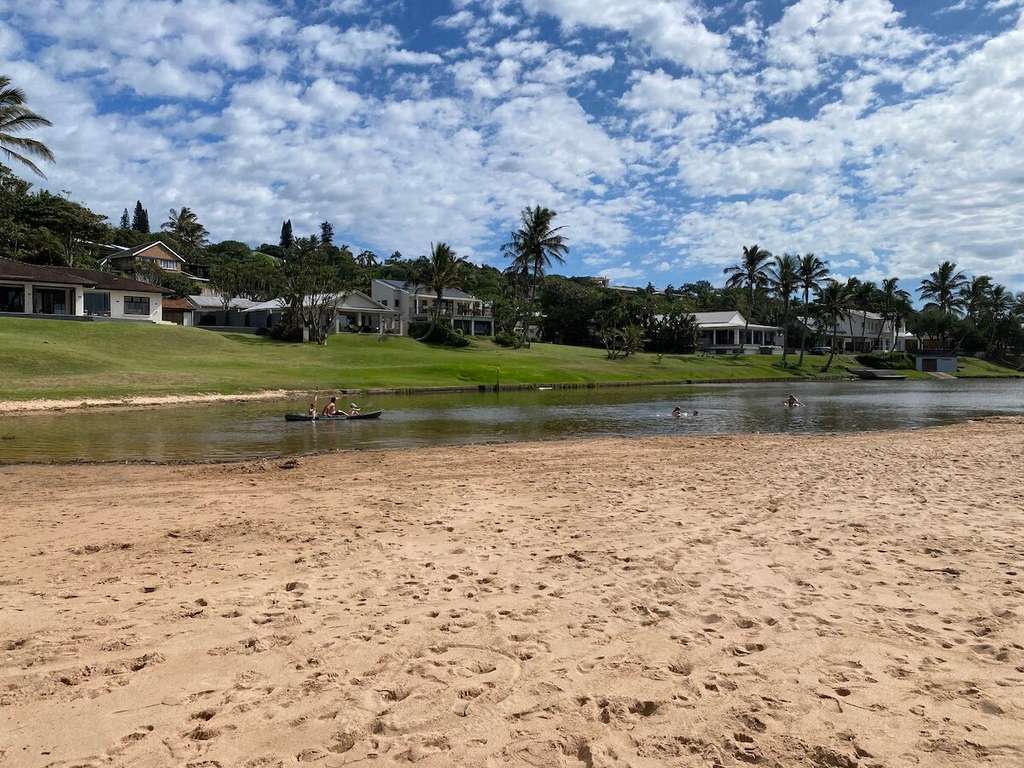
The lagoon is the one most families choose. It is warm, shallow, and almost always calm. The sandy bottom is visible, the current is gentle, and children can wade comfortably in water well below waist height for long stretches of the bank. The lagoon mouth area, where the water narrows on the sandbar before meeting the ocean when the lagoon overflows, is where the current picks up on an outgoing tide. That is the stretch where you see children on boogie boards.
Access to both the beach and the lagoon is free. Parking is at the Zinkwazi main beach car park, which is free and managed with a boom gate during peak season. When it fills, the boom is closed and a security guard mans the entrance. Overflow parking is on Nkwazi Drive, including on the grass verges along the beachfront road. Arrive early in December and January if you want a parking spot without the walk. Restrooms are available in the Ski Boat Club and there are outdoor toilets and showers at the lifeguard centre next to the lagoon.
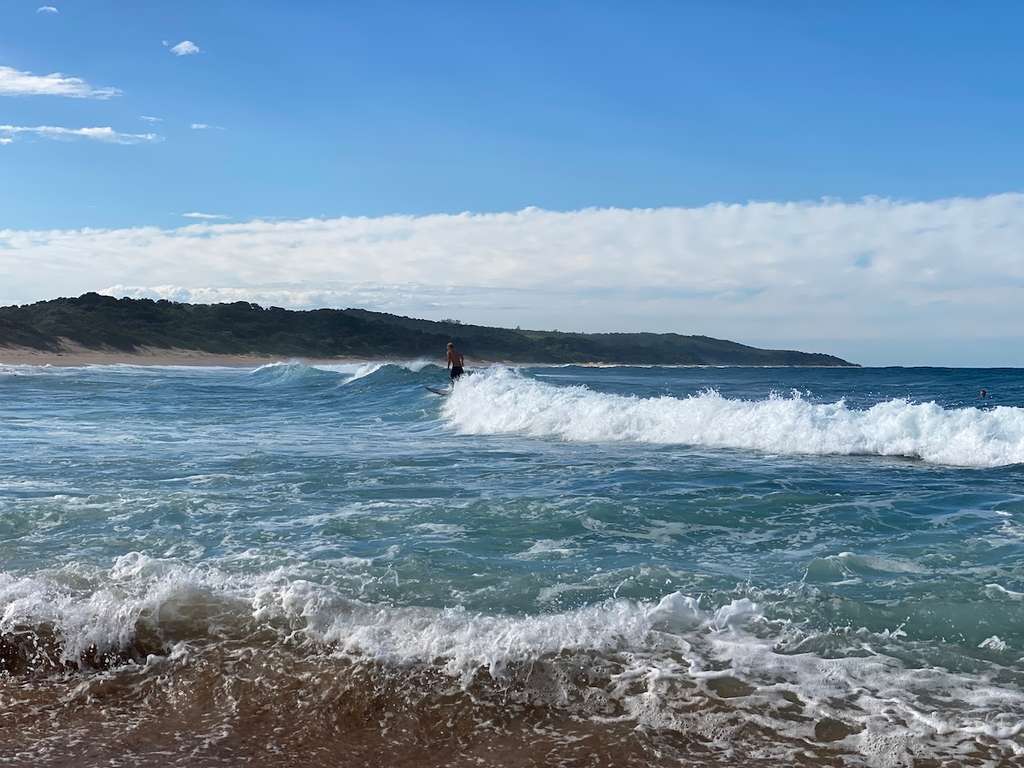
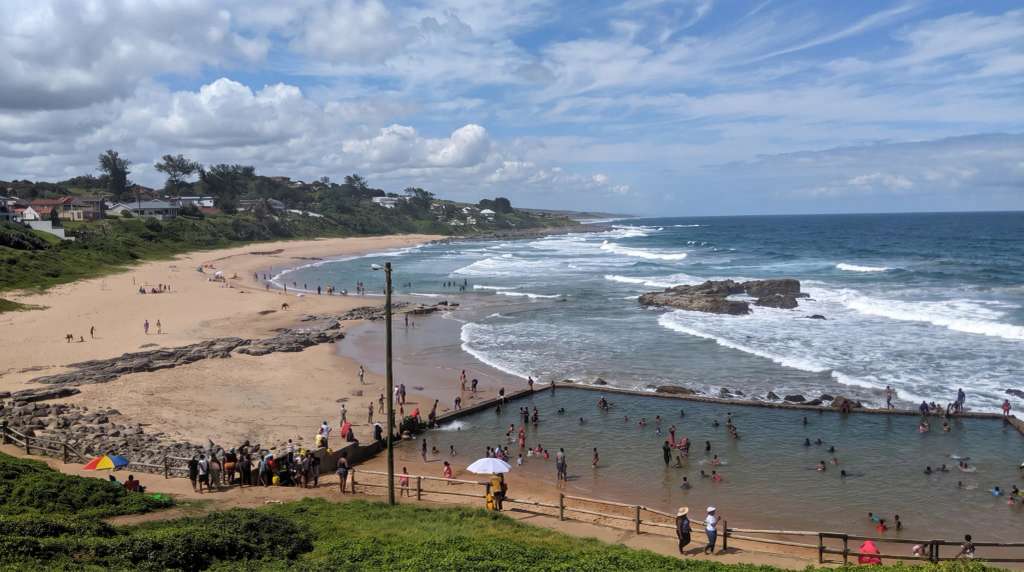
The main beach is the ocean beach, with proper surf and the unpredictability that comes with open water. Lifeguards are on duty and it works well for confident swimmers. On flat days the water is clear and calm enough for snorkelling around the rock formations on either side of the beach.
Black Rock Park, about 500 metres to the south of the main beach, has its own free parking and beach access. Lifeguards tend to appear there during peak season and busy weekends, but coverage is not consistent at every spot along the Zinkwazi shoreline. Worth knowing before you take young children to a new spot.
Fishing in Zinkwazi
The shore fishing at Zinkwazi is productive enough that you will regularly see people who made the drive for it alone, not people who happened to bring a rod. Tidal timing makes the biggest difference: the last two hours before high water on an incoming tide tends to produce the best results from shore, with early morning and late afternoon generally more reliable than the midday lull on a flat, low sea.
Three spots are the go-to for shore fishing. The main beach at the Ski Boat Club is the most accessible, with free parking in the main beach car park. Jamie's Beach has street parking on Magai Drive. The very end of the street has free but limited space, so claim your spot early. Black Rock Park has its own free parking in the park at the entrance, about 500 metres to the south of the main beach.
Shad run the beach reliably during the warmer months. Kob and garrick are the targets for anglers working the gullies and rock edges with larger baits. At Black Rock the canoe launch is used by sea kayakers who want to get beyond the shore break and work the nearshore reef, a worthwhile option when the sea is calm and the wind is off.
Bait is not readily available in Zinkwazi itself. The Zinkwazi Beach Cafe may stock basic tackle, but do not rely on it without checking first. The more reliable approach is to bring your own bait from KwaDukuza, which has fishing tackle shops and is approximately 15 to 20 minutes away on the N2. A South African recreational fishing licence is required by law for all shore angling, so obtain one through the relevant provincial authority before your trip.
For deep-sea fishing, the Zinkwazi Ski Boat Club is the platform for everything offshore.
For scuba diving, snorkelling and offshore boat experiences, Zinkwazi Dive Charters runs trips from the main beach with all kit included, ranging from introductory dives to PADI Open Water and Advanced Open Water courses. Safari fun boat rides are available for non-divers. There is more to fishing in Zinkwazi than most visitors realize before they arrive.
Birdwatching
The window is early. Before 8am, before the beach crowd arrives, before the boats have launched. That is when Zinkwazi belongs to the birds. The fish eagles call first, usually from somewhere along the lagoon bank, and once you have heard that sound over open water it does not leave you.
The Zinkwazi conservancy sits on the Zululand Birding Route and has over 250 recorded species across three distinct habitats: the lagoon edge, the coastal dune forest of the Zinkwazi Forest Trails, and the open beach. Each habitat produces different species at different times of day. The lagoon edge at low tide draws waders, herons, and kingfishers. The forest is best in the early morning for forest specials. The beach itself is worth scanning at first light for terns and coastal raptors.
A breeding pair of Crowned Eagles holds territory in the iLala forest area to the south of the village. The Crowned Eagle is Africa's most powerful bird of prey and it is genuinely rare to find a breeding pair in close proximity to a coastal village. It is not a guaranteed sighting, but serious birders who time it with the breeding season and know the iLala forest trails have a reasonable chance.
Zinkwazi does not announce itself. It just quietly gets into you, the way a place can when it has nothing to prove and nowhere to be.
Whale watching and dolphins
Humpback whales migrate north past the Dolphin Coast between June and November. The peak is July, when the numbers are at their highest and the whales pass close enough to watch without any equipment. Most years the sightings are from shore. Some years they surface close enough that you can hear the blow.
The best viewing spots are directly from the beach or from the elevated vantage points above the bay. Picnic tables on Panorama Drive and Glen Drive both look out over the water below, and from up there you get a much wider field of view than from beach level, which makes it considerably easier to pick up a blow further out. Both spots are accessible by car, free, and require no booking. Drive up, find a table, and wait.
June is worth separating out because it coincides with the sardine run, the annual migration of billions of sardines up the east coast that triggers a feeding frenzy involving sharks, dolphins, gannets, and whales simultaneously. From the headland at Zinkwazi during a good sardine run, the ocean surface can be alive with activity across a wide area. It does not happen every year at the same intensity, but when it does it is one of the more remarkable natural events on the South African coastline.
Dolphins are a year-round presence on this stretch of coast. Common dolphins and bottlenose dolphins both occur here, and early mornings are the most reliable time to spot them working the shallows before the beach fills up.
Kayaking and paddleboarding on the lagoon
The lagoon rewards an early start. By 7am on a calm morning the surface is flat, the light is coming in low from the east, and the fish eagles are still active on the western bank. The full length from the mouth to the far upper reaches is approximately eight kilometres each way, so allow two hours minimum for the return at a relaxed pace.
The water is warm enough year-round to paddle comfortably. The upper lagoon narrows and becomes more forested as you go further inland, and the birdlife along that stretch is different from the open lower lagoon: quieter, more sheltered, with different species in the canopy above the water.
There is no formal kayak or paddleboard rental operation at Zinkwazi, but some self-catering properties have equipment available, so it is worth checking with your host before booking if this matters to you. Otherwise, bring your own. The lagoon is accessible from the main beach at no cost.
Leonatis Park
Across from the entrance to the Zinkwazi Forest Trails on Palm Drive sits Leonatis Park, a small public green space named after the wild dagga plant (Leonotis leonurus) that grows along the KwaZulu-Natal North Coast. It is the kind of place locals know and visitors do not, which is why it is worth flagging.
The park works well for dog walking and for the kind of low-key time outside that does not need a program. There is grass, there is shade, there is space for a ball or a frisbee, and the forest is quite literally across the road if you want to extend the morning into the trails. Most people who use Leonatis Park are on foot from a self-catering property in the village, and the park itself is free with no opening hours to worry about.
Pair it with the Forest Trails for a longer outing: park session first, trail walk after, both within a few hundred meters of each other on the same road.
The Zinkwazi Forest Trails
The forest trails are one of the least-publicised things at Zinkwazi and consistently among the most memorable. They run through coastal dune forest behind the lagoon: milkwood, iLala palms, and the kind of dense subtropical vegetation that keeps the trail cool even on hot mornings. Entry is free.
Park on the grass verge on Palm Drive next to Leonatis Park. There is no designated parking area at the 31 Palm Drive entrance, and roadside grass parking is simply how most people arrive and it works fine. The access point is well-signed from there.
Dogs are welcome and the trails are generally off-lead friendly, but always carry a lead and use your judgement depending on who else is on the trail. Morning is the best time: the forest is quieter, the birds are more active, and the temperature is manageable before the day heats up. The trails vary in length and can be combined for a longer outing.
The trail network also connects to routes through the surrounding sugarcane fields for those who want a longer walk or run. The terrain shifts quickly from indigenous forest to open agricultural land, with the lagoon and coast visible in the gaps. Each route through the Zinkwazi trails has its own character and distance.
Beach walks
The beach at Zinkwazi offers two distinct walks from the main beach, and both are best done at low tide when the sand is firm and the route is widest.
Walking north beyond the main beach leads you to the Boiling Pots, a rocky coastal outcrop where the ocean surges through the rock formations. Barefoot is fine for this one, and it takes about 30 to 45 minutes at an easy pace from the Ski Boat Club. The atmosphere there is raw and exposed compared to the sheltered main beach, and the sound the ocean makes through the rocks is particular to that spot.
Walking south to Grumpy's Bush and Beach Restaurant is a different undertaking entirely and deserves proper preparation. The full walk runs past Jamie's Beach, past the Nonoti River mouth, along the beach at Prince's Grant and all the way to Grumpy's, which has direct beach access and a good seafood menu. The total distance is 12 to 13 kilometres depending on where you start from the village and takes 2.5-3hrs+. Always walk in groups. Low tide is the easiest: the sand is firmer and the route is clearer. Wear sandals or proper shoes for the distance, not bare feet. Bring water, snacks, sunscreen, and a hat. The walk passes some excellent shelling ground along the way, so a small bag is worth bringing. Grumpy's is open 9am to 6pm and gets busier on weekends. Worth knowing before you commit to the walk. You will need someone to collect you on the other side.
The village streets are also worth walking in their own right. The roads meander up and down the hills with views over the forest canopy and the coast below. Early morning or late afternoon, when the light is low and the temperature is reasonable, is the time to do it properly.
Surfing
The main Zinkwazi beach works for a range of experience levels and has lifeguards on duty, with south and south-east swells producing the most consistent conditions. More experienced surfers use Jamie's Beach for a different quality of wave, but there are no lifeguards there, so know what you are paddling into before you go.
There are no board rentals at Zinkwazi and no surf school or lessons at the beach. Some self-catering properties have surfboards available, so check with your host before booking if this matters. Otherwise bring your own from home, or pick up what you need in Ballito, approximately 30 to 35 minutes south on the N2.
Running
Zinkwazi has more running options than most coastal villages of its size. The village roads give you a solid base run with enough elevation change to be interesting: coastal views open up at the high points and the terrain varies enough to keep it honest. But the two routes that locals come back to are both in the sugarcane fields to the side and above the village, and both require a GPX file. The offshoots in the fields are numerous and it is easy to go wrong without a track to follow.
For serious trail runners, Holla Trails is 43km, approximately 35 minutes from Zinkwazi at Collisheen Estate in Umhlali. It is South Africa's largest MTB trail network with 300km of marked trails across 42 sugarcane farms, with a day permit of approximately R83 per adult. Dog-friendly on lead.
Entry is via a biometric turnstile or mantrap gate. Members are loaded onto the database and access by face scan. Day visitors receive an access code at the trailhead, so bring a valid ID. Present your face to the scanner or enter the code and the gate opens. Worth knowing before you arrive so the process does not catch you off guard on an early start.
The Blue Route is the one worth making the early start for. Approximately 14 to 15km, 317m of elevation gain, and a loop that earns its distance: fast flat sections through the sugarcane, proper climbs, technical stretches through forest, and enough variety that it holds your attention the whole way around. The route passes through Fairview Estates, adding a change of scenery mid-run. The kind of run that justifies the drive. Download the Holla Blue Route GPX before you go.
Padel and mini golf
Zinkwazi Padel has two courts and can be booked through the Playtomic app. Court hire is R400 for one hour or R600 for 90 minutes. Both courts have lights for evening play, which makes them genuinely useful in summer when the daytime heat makes outdoor sport uncomfortable before late afternoon. Book one to two days ahead in peak season. The courts fill up fast in December and July.
On site there is a small padel shop stocking accessories, and rackets and balls are available to rent if you have not brought your own. Behind the courts there is a bar with outdoor seating that connects through to the mini golf area at Zinkwazi Lagoon Lodge. The layout works well as an afternoon out for a mixed group: one group on the courts, drinks at the bar, children on the mini golf. It tends to work out. Most visitors do not know the mini golf is there until someone local tells them.
For a round of golf, Prince's Grant Golf Estate is 21km, approximately 28 minutes from Zinkwazi and open to visitors. It sits on the clifftop above the beach with ocean views along most of the course, but it is outside Zinkwazi Beach itself. Confirm current green fees and tee time availability directly with the club before making the trip.
Black Rock Park
Black Rock Park deserves a mention as a destination in its own right rather than just a fishing landmark. It is a public park with braai facilities, picnic areas, and direct beach access about 500 metres to the south of the main beach, more private and shaded than the main beach car park, with a setting that lends itself to a proper morning out rather than a quick stop.
The beach launch at Black Rock is also the access point used by sea kayakers and canoe fishers working the nearshore water. It is not a jetty launch but a natural gap in the rock formations that gives a relatively protected entry to the sea, manageable in calm conditions and best left alone when the swell is up.
Zinkwazi has a way of filling a week without anyone having planned it that way. The lagoon takes the mornings, the beach takes the afternoons, and somewhere in between the fishing, the trails, the padel courts and the Thursday happy hour at the Ski Boat Club, you realise you have not checked your phone in two days. That is more or less the point.
All the local businesses, venues and activities mentioned here are listed under experiences at Zinkwazi Beach, and if you are still looking for somewhere to stay, Zinkwazi has many self-catering options including lagoon-side cottages, beach houses, pet-friendly places, and the houses set back in the milkwood forest.