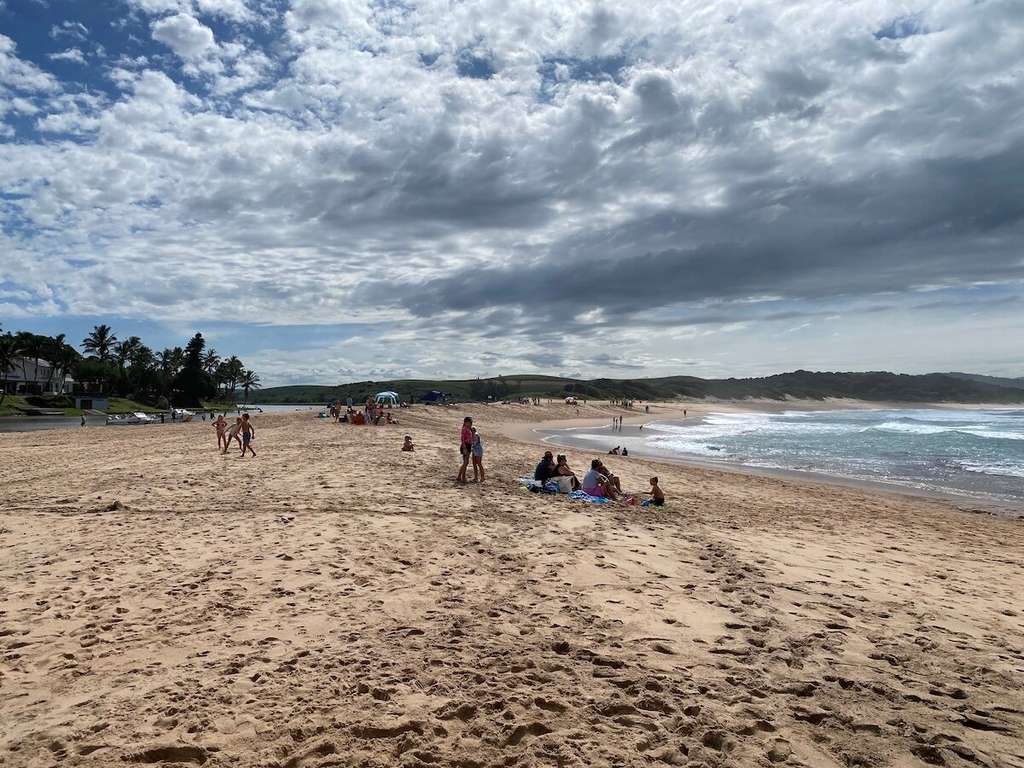
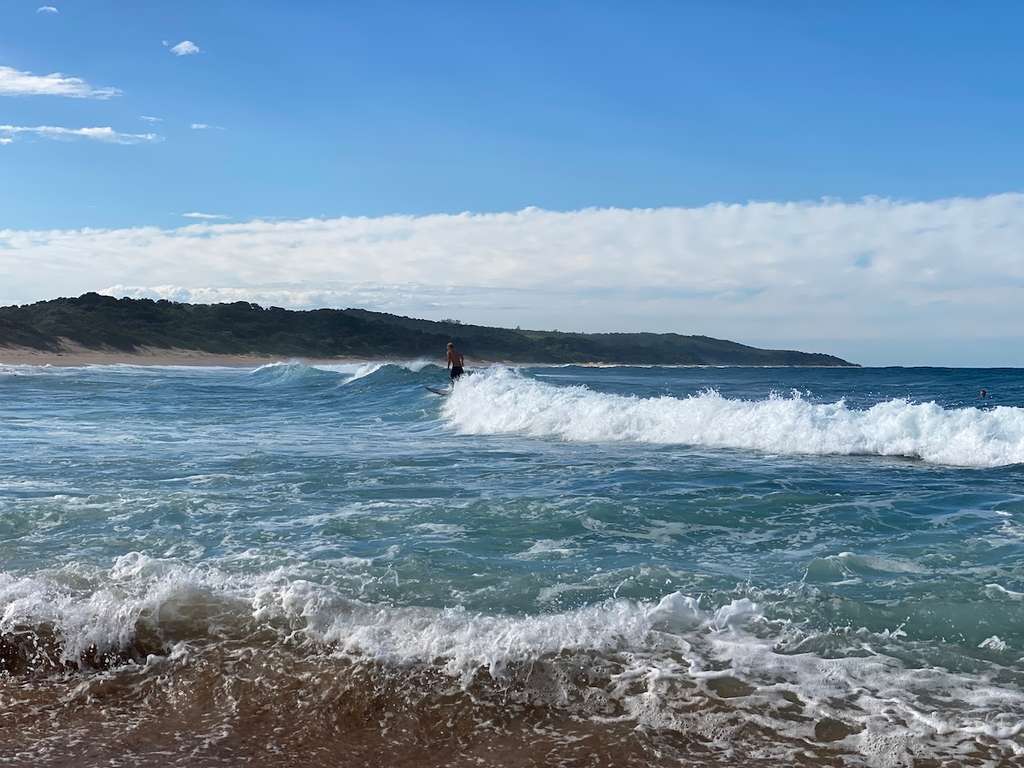
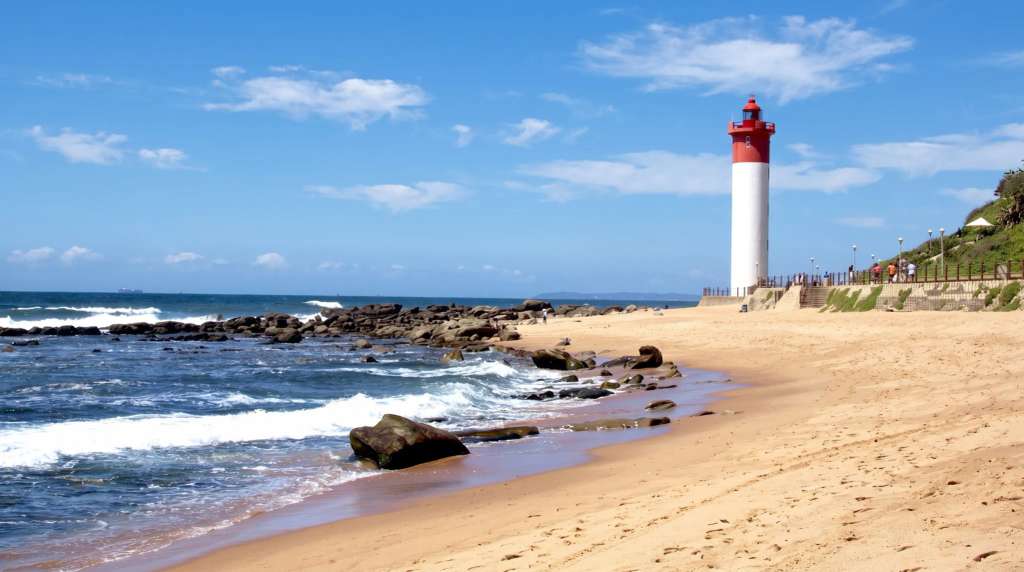
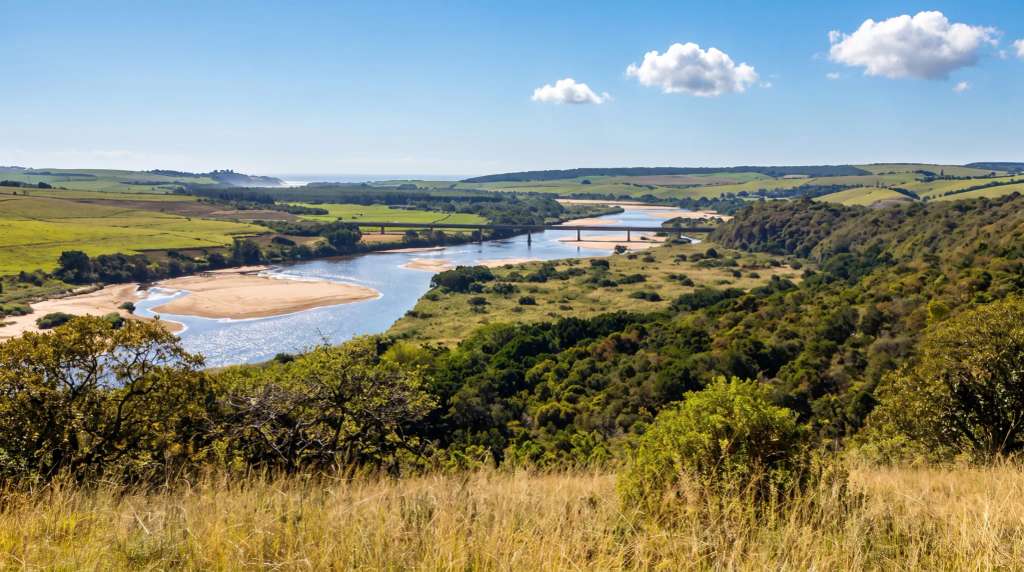
The KZN North Coast is called the Dolphin Coast for a reason. Bottlenose dolphins are year-round residents along this stretch, with pods of 30 to 50 routinely seen patrolling just beyond the breakers. Whales are the seasonal headline. Every year from June, humpback whales migrate north from Antarctic feeding grounds toward the warmer waters off Mozambique. The route takes them close to the KwaZulu-Natal coastline. Close enough that from an elevated headland on a calm winter's morning you can watch them pass without leaving the shore. The KZN North Coast sits in the heart of this migration corridor. Zinkwazi Beach sits at the northern end of the Dolphin Coast.
Humpbacks are the dominant whale species, frequently seen breaching (the full body clearing the water) and spy-hopping, lifting their heads vertically above the surface as if to look around. Southern right whales appear occasionally on this stretch. The whale season runs June through November: northward migration peaks in July, the southward return is active from August through November. Two windows, two directions, the same stretch of ocean.
How you experience it depends on what you want. From the viewing points above the bay you might catch a blow on the horizon, a breach if conditions are right, or the bow-riding shapes of bottlenose dolphins on any month of the year. From a boat in the migration corridor, you are alongside them.
When do humpback whales pass the Dolphin Coast?
Humpback whales migrate north along the KZN coast from June through July on their way to warmer breeding grounds. According to the South African Whale Network, July is the peak month for numbers on the northward migration. From August through November, the same animals move south again on their return.
June and July also coincide with the sardine run moving up the coast, and during a good year the convergence of sardines, sharks, gannets, dolphins and humpbacks offshore creates one of the more extraordinary natural spectacles on the South African coastline. For the best time to visit Zinkwazi in relation to the whale season, July offers the most reliable combination of whale numbers, dry weather and calm winter seas.
Dolphins on the Dolphin Coast
The KZN North Coast got its name from the bottlenose dolphins that live here year-round, not from the whales that pass through. The named Dolphin Coast region runs from the Tongaat River in the south to Zinkwazi Beach and the Tugela River mouth in the north, putting Zinkwazi at the upper boundary of the stretch. Pods of 30 to 50 bottlenose dolphins are routinely seen riding the surf just beyond the breakers, often visible from the elevated viewpoints above the bay.
Bottlenose dolphins (Tursiops aduncus) are the species you are most likely to encounter at any time of year. Approximately 900 individuals are resident along the KZN coast across the seasons. They are the most acrobatic of the inshore species, frequently bow-riding boats, surfing the breakers, and tolerating close approaches from surfers and swimmers. They feed on bony fish and squid in collective hunts. Group size in KZN tends to be smaller than in the Garden Route, which marine biologists attribute partly to historical dolphin by-catch in the regional shark nets.
The numbers shift during the sardine run. Approximately 3,000 bottlenose dolphins extend their range up the KZN coast at this time, with some super-pods exceeding 1,000 animals working the bait balls together. This is the period when offshore activity is at its most intense. Common dolphins (Delphinus capensis) also appear inshore during summer when they follow schooling fish up the coast, sometimes in large pods.
The Indo-Pacific humpback dolphin (Sousa chinensis) is the rare and shy species on this stretch. Listed as Endangered in South Africa per the Marine Protected Areas SA reference, the total national population is approximately 500 individuals, split between a Cape population and a northern KZN population. Sightings are uncommon. Encounters are notable when they happen.
Watching from shore at Zinkwazi
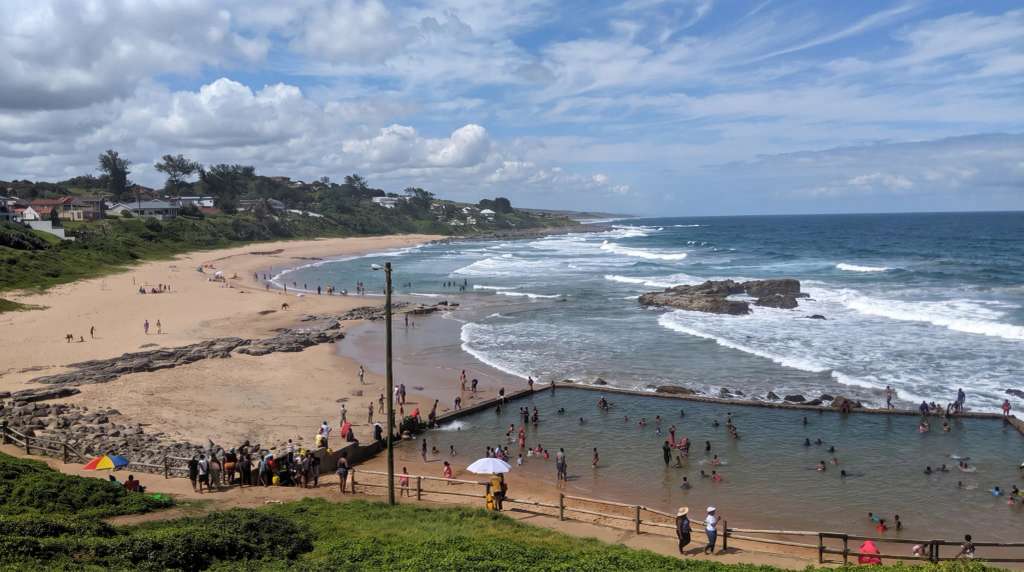
Shore-based whale and dolphin watching from Zinkwazi is possible but not guaranteed. The elevated viewpoints on Glen Drive and Panorama Drive above the bay give the widest field of view and are the best spots to scan from. From up there you are looking down at a wide arc of open ocean, which makes it considerably easier to pick up movement than from beach level where the horizon is compressed.
Binoculars help. A whale's blow is usually the first sign: a hazy white puff that disappears quickly, followed by the dark curve of a back rolling through the surface. Breaches are less common but do happen within view of the headland on calm days. A humpback breaching, the full body clearing the water, is one of those moments that stops a conversation mid-sentence. For dolphins, look for the synchronised arc of multiple backs surfacing together, often closer to shore than you would expect.
Morning light is better than afternoon for spotting against the water. A calm, clear winter's day with no wind chop makes any movement on the surface easier to pick up. Both viewpoints are accessible by car, free, and require no booking. Drive up, find a spot, and scan patiently.
"An animal the length of a bus moving through the water with an ease that makes the ocean feel small."
Getting on the water with Dive Zinkwazi
For a closer encounter, Dive Zinkwazi runs boat trips from Zinkwazi Beach during the whale season. Getting on the water changes everything. The scale of a humpback makes no sense until you are alongside one: an animal the length of a bus moving through the water with an ease that makes the ocean feel small. The sound of a blow at close range, that loud exhale and the mist it throws, is something no photograph captures properly.
Humpbacks are generally curious animals and will sometimes approach a stationary boat deliberately, circling underneath before surfacing again. Dolphins similarly will bow-ride or surf the wake of a moving boat, often switching from one side to the other to inspect passengers. There are no guarantees on any trip. Whales are wild animals on a migration route, not a schedule. But the offshore water off Zinkwazi sits in the heart of the migration corridor between June and November, and the Dive Zinkwazi team know these waters well. Part of what makes the experience worthwhile is exactly the uncertainty.
The sardine run
Every year between late May and mid-July, peaking in June, billions of sardines migrate north from the cold Agulhas Bank waters up the east coast of South Africa. The South African Association for Marine Biological Research (SAAMBR) documents this as one of the largest marine migrations on earth. The sardines attract sharks, Cape gannets diving from above, dolphins herding them into bait balls, and humpback whales feeding at the surface, all converging in the same stretch of ocean at the same time. Birdwatching at Zinkwazi covers the gannet activity and the wider seabird offshore presence.
The sardine run does not happen at the same intensity every year and its timing shifts. When it coincides with the July whale migration at its peak, the offshore water off Zinkwazi can be extraordinarily active. When it does not, June and July are still productive for whale watching. It is the bonus, not the guarantee. Fishing at Zinkwazi Beach covers the offshore reefs and the species that benefit from the sardine activity.
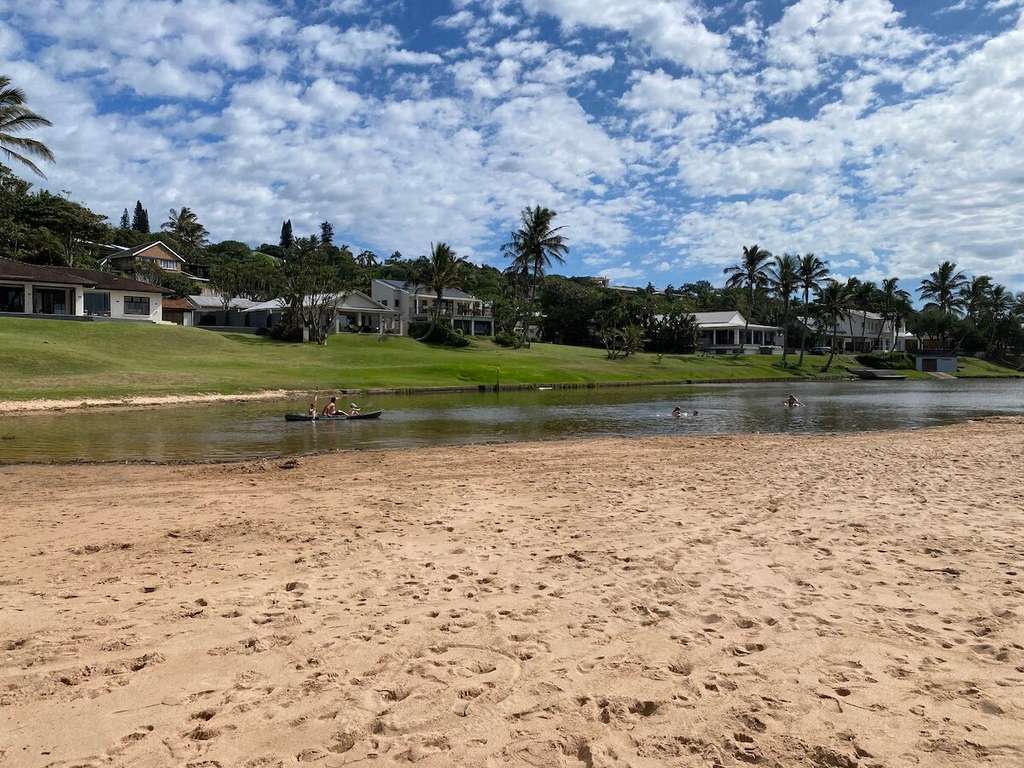
If you are planning a winter visit, Zinkwazi has many self-catering options including lagoon-side cottages, beach houses, pet-friendly places, and the houses set back in the milkwood forest. Beach houses near the main beach put you closest to the elevated viewpoints on Glen Drive and Panorama Drive. The Ark looks out over both the shore break and the lagoon, which makes for easy scanning from the pool deck.
Frequently asked questions
Published April 14, 2026