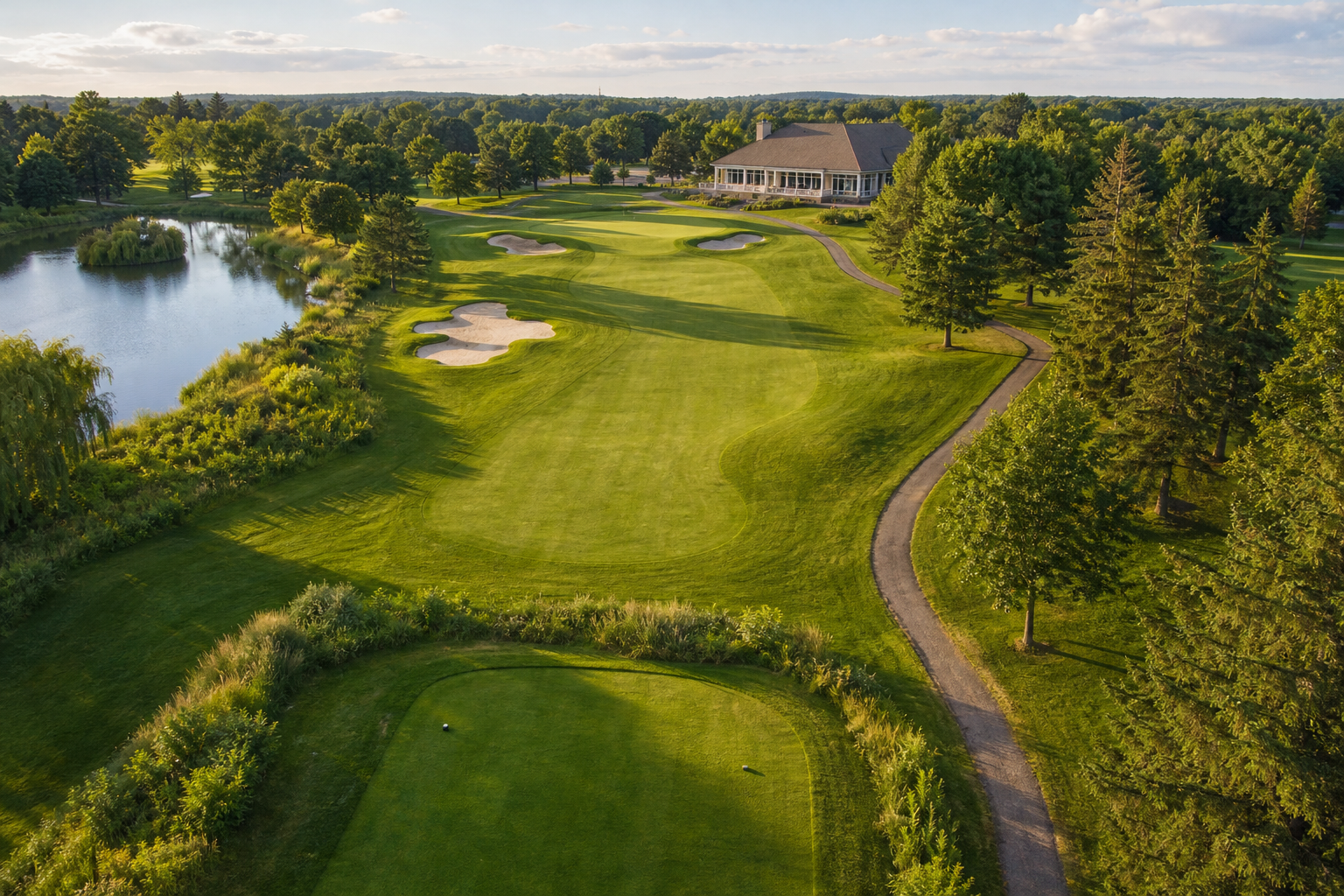
About 75% of golf courses in the United States are open to the public, meaning the nearest course to almost any address is likely one you can book without a membership.
Find and book a public course near you
Find public courses near you and book a tee time on your own schedule, no membership card required.
What makes a course truly public
A public golf course is open to any golfer who shows up and pays the greens fee. No membership application, no sponsor, no waiting list. That single distinction separates public facilities from private clubs, which restrict play to members and their guests, and from semi-private courses, where members hold priority tee times but non-members can still book a round.
About 75% of golf courses in the United States are open to the public, covering both municipally funded facilities and privately owned daily-fee courses. A municipal course is operated by a city, county, or park district and is typically designed to serve the local community. A daily-fee course is privately owned but open to the public on a pay-per-round basis. Both types welcome walk-ins and advance bookings alike, making them the practical choice for infrequent golfers, travelers, and anyone who wants to play without a long-term financial commitment.
How greens fees are structured and what drives them
The greens fee covers your access to the holes and use of the greens. Everything else, including a cart, range balls, club rentals, and food, is typically priced separately unless the course explicitly bundles them. Cart fees are often charged per person, and some courses require carts on certain days or for certain tee times.
What you pay varies considerably based on course type. Municipal courses tend to sit at the lower end of the pricing spectrum. Daily-fee courses occupy a middle range. Resort-affiliated public courses and ultra-premium facilities sit at the top. Beyond course category, location, season, time of day, and day of the week all move the number. A weekend morning tee time at a well-regarded resort course will cost meaningfully more than a weekday afternoon slot at a county municipal layout.
Regional pricing patterns worth knowing before you search
Green fees are not uniform across the country. GreenFeeTracker monitors public golf green fees across more than 210 markets in 49 states, covering over 9,145 courses, and the spread between the most and least expensive markets is substantial. States like Oklahoma, Alabama, and Mississippi consistently rank among the most affordable for public golf, while resort-heavy markets in Nevada and Arizona sit at the opposite end.
Florida hosts more public golf courses than any other tracked state, and year-round demand creates genuine price competition among courses in markets like Gainesville, Daytona Beach, and Lakeland. Ohio's major metros, including Columbus, Cleveland, and Cincinnati, have dense public course populations where municipal and county facilities keep the floor of the market accessible. Knowing your region's baseline helps you recognize when a course is priced at a premium and when it represents typical local value.
Twilight rates, off-peak windows, and other ways to time your round
Most public courses price tee times dynamically, meaning the same 18 holes can cost noticeably less in the late afternoon than it does at 8 a.m. on a Saturday. Twilight rates, which typically begin a few hours before sunset, are one of the most consistent ways to play a quality course at a lower greens fee. Off-peak windows, often weekday mornings or early afternoons, follow the same logic.
Booking in advance online is now standard at most public facilities and often unlocks the best available rates for a given window. Some courses also offer loyalty programs or season passes for frequent local players. If you plan to play the same course regularly, asking about these options at the pro shop is worth the conversation.
What to compare when choosing between nearby courses
Once you have a list of public courses within a reasonable drive, a few factors separate a good fit from a frustrating round. Yardage and slope or difficulty rating tell you whether the layout suits your current game. Practice facilities, including a driving range, putting green, and short-game area, matter if you want to warm up properly or work on your game between rounds.
Club rentals are worth confirming in advance if you are traveling without your own set. Rental availability varies by course, and so does quality. For golfers who want to make a day of it, checking whether the course has a restaurant or at least a snack bar is practical. Finally, reading recent reviews on local guides and course-specific platforms gives you a ground-level sense of conditioning, pace of play, and staff friendliness that yardage charts cannot.
How to find and book a public course near you
- 1
Search by location and course type
Start with a location-based search using terms like "public golf courses near me" or the name of your city plus "public golf." Filter results by course type if the tool allows it: municipal, daily-fee, and resort public courses each offer a different experience and price range. Local guides and community platforms can surface courses that national booking apps overlook, particularly smaller municipal layouts that serve neighborhoods rather than tourists.
- 2
Check yardage, rating, and difficulty
Every course publishes its yardage from multiple tee boxes and a slope or course rating. Slope rating is the most reliable single number for gauging how demanding a layout will be for a bogey golfer: the higher the number, the harder the course plays relative to par. If you are newer to the game, look for courses with multiple forward tee options so the layout is genuinely playable, not just technically accessible.
- 3
Confirm what the greens fee includes
Before booking, read the fee description carefully. A listed greens fee may or may not include a cart, and some courses require carts at certain times. Club rentals, range balls, and food are almost always priced separately. If you are traveling without clubs, call ahead to confirm rental availability and quality rather than assuming every course stocks a full set.
- 4
Look for twilight and off-peak windows
Check the course's tee sheet for twilight or off-peak slots, which are typically available in the late afternoon on any day and throughout the day on weekdays. These windows offer the same fairways and greens at a lower greens fee than peak morning times. If your schedule is flexible, playing during off-peak hours is the most straightforward way to stretch your golf budget without sacrificing course quality.
- 5
Book online or call the pro shop
Most public courses allow online booking through their own website or a third-party tee time platform. Online booking is often the fastest way to see real-time availability and lock in a specific time. If you prefer to ask questions first, calling the pro shop directly lets you confirm cart policies, rental availability, dress code, and pace-of-play expectations before you arrive. Booking at least a few days ahead is advisable on weekends at popular courses.
- 6
Arrive early and use the practice facilities
Arriving at least 30 minutes before your tee time gives you a chance to check in, warm up on the range or putting green, and get a feel for the course conditions that day. Many public courses have a driving range and short-game area included with or available alongside the greens fee. A proper warm-up improves your round and keeps pace of play moving for everyone on the course.
Benefits
No membership required to play
Public courses are open to any golfer who pays the greens fee. Walk-up access and online booking mean you can plan a round days in advance or decide to play the same morning.
Wide range of course types available
From city-run municipal layouts to privately owned daily-fee courses and resort facilities, public golf covers a broad spectrum of difficulty, conditioning, and amenities to suit different skill levels and budgets.
Flexible pricing through off-peak windows
Twilight rates and weekday tee times make it possible to play quality public courses at a lower greens fee than peak weekend slots, giving flexible golfers a genuine advantage.
Most US courses are publicly accessible
About 75% of golf courses in the United States are open to the public, meaning the nearest course to almost any address is likely one you can book without a membership.
Rental equipment lowers the barrier to entry
Most public courses offer club rentals, so golfers who are new to the game or traveling without their own equipment can still play a full round without a prior investment in gear.
Situations where public courses make the most sense
A traveler wanting a round in an unfamiliar city
A golfer visiting a new city for work or leisure can book a tee time at a local public course without any prior connection to the area. Public courses accept walk-up and advance bookings from anyone, making them the default option for traveling golfers. Checking a local guide for the destination city before arriving helps identify which courses locals actually recommend, rather than defaulting to the first result in a booking app. If you are also looking for places to eat after your round, a resource like local restaurant guides can round out the day.
A beginner playing their first rounds
Public courses are the natural starting point for new golfers. No membership is required, and many municipal layouts are designed with accessibility in mind, offering shorter yardage options and forgiving layouts. Club rentals mean a beginner does not need to invest in equipment before deciding whether the game is for them. Calling ahead to ask about beginner-friendly tee times or lessons available through the pro shop is a practical first step.
A group organizing a casual outing or event
A group of colleagues, friends, or community members planning a casual golf day will find public courses far more accommodating than private clubs. Most public facilities can handle groups booking multiple consecutive tee times, and some offer shotgun starts or event packages for larger outings. Confirming group booking policies and cart availability well in advance prevents logistical surprises on the day. For groups that want to extend the event beyond the course, pairing it with a winery visit or a dinner reservation makes for a fuller outing, and local winery guides can help with that planning.
A local golfer exploring courses in their own region
Even experienced local golfers often play the same two or three courses out of habit. Searching a local guide for public courses in neighboring towns or counties can surface layouts worth the short drive. Regional pricing patterns vary significantly, so a course one county over may offer a meaningfully different experience at a different price point. Exploring the broader local golf scene is one of the more satisfying ways to keep the game fresh without traveling far.
Common questions about public golf courses near you
Browse public golf courses locals actually recommend
Whether you are planning your first round or looking for a new course to add to your rotation, Local Eyes helps you find what locals actually recommend in your area. Browse golf listings, read community reviews, and discover the courses worth the drive.